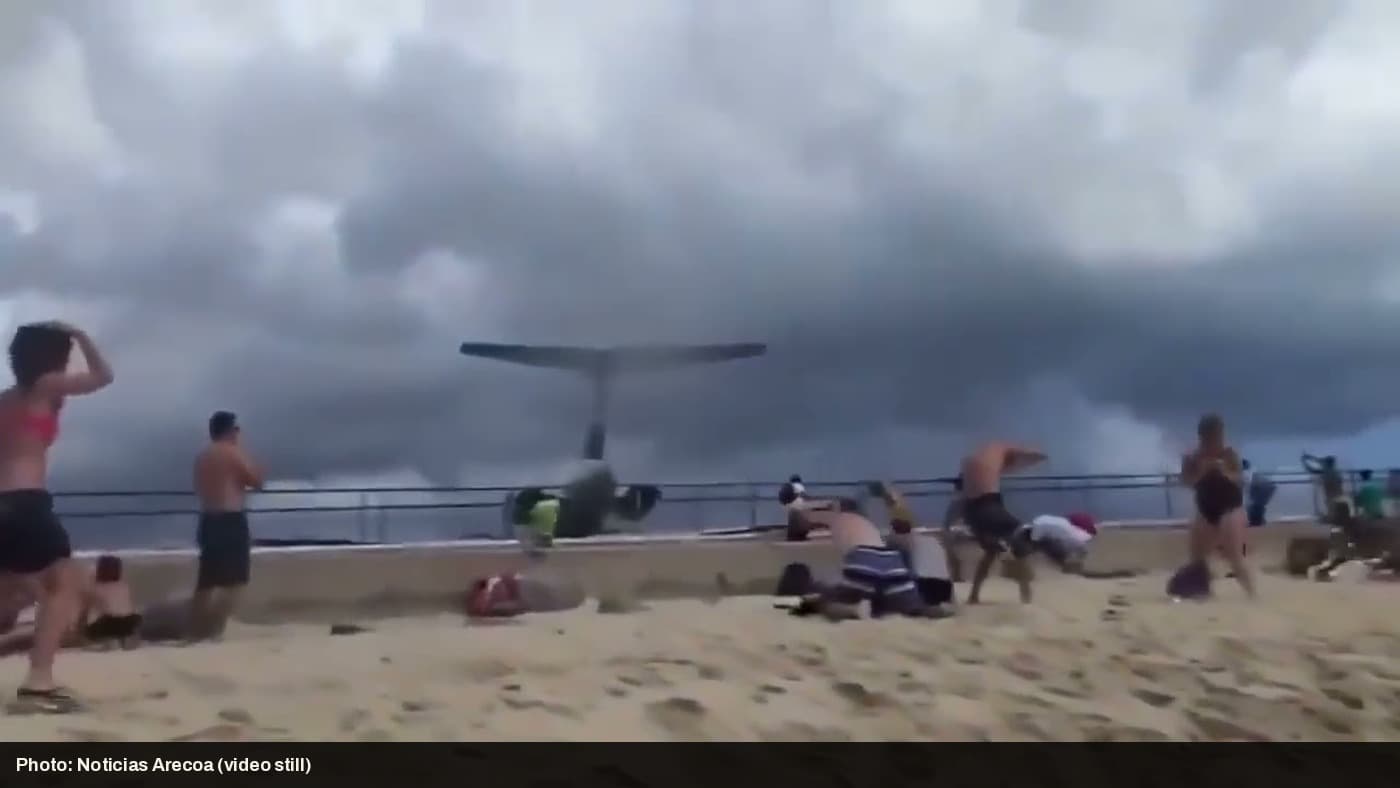
They were holding the guardrail the way people always do at this particular stretch of sand — phones up, feet braced, waiting for the moment the big jet at the end of the runway let go of the brakes. On September 8, 2026, dozens of tourists packed against the fence at Maho Beach in Sint Maarten watched an Insel Air McDonnell Douglas MD-80 line up for takeoff a few dozen meters away. Seconds later, most of them were on the ground.
The MD-80's twin tail-mounted engines, each capable of roughly 18,500 to 21,000 pounds of thrust, spooled up and threw a wall of hot exhaust straight down the beach. Sand lifted off the ground in sheets. Towels, hats, and beach bags tumbled end over end. People who'd been standing upright a moment earlier were suddenly on their hands and knees, crawling to keep from being dragged, while others toppled backward into the sand entirely.
A Beach Built Around a Runway
Maho Beach exists in the shadow of Princess Juliana International Airport's runway threshold, separated from landing and departing aircraft by a low fence and a two-lane road. Planes on final approach pass so low overhead that visitors can, and regularly do, reach up and nearly touch the landing gear. It's made the beach one of the most photographed stretches of sand on earth — and one of the most quietly dangerous, for the exact opposite reason people come to see it.
Nobody was seriously hurt on September 8. This time, it was scrapes, bruised pride, and a video that raced around Instagram, TikTok, and Threads within hours, drawing the same argument it draws every time: half the comments marveling at the spectacle, the other half asking why anyone would stand there in the first place.
The Warning Signs Are Not New
That argument has a body count behind it. On July 12, 2017, a 57-year-old New Zealand woman was gripping that same fence when a departing jet's blast threw her backward. She died later that day at Sint Maarten Medical Center. A woman had already been injured there in a similar incident five years earlier, in 2012.
After the 2017 death, Sint Maarten's tourism director, Rolando Brison, met personally with the woman's family. "They recognized that what they did was wrong, through the clearly visible danger signs," he said afterward — signs that are bolted directly to the fence and read, in plain block letters: DO NOT STAND. DANGER. JET BLAST.
Why People Keep Standing There Anyway
The signs haven't emptied the beach, and they likely never will. Maho Beach's entire draw is proximity — the ability to feel, physically, what an arriving or departing airliner is capable of, from a distance no other public beach on the planet allows. Airport and tourism officials have spent years trying to strike a balance between preserving that draw and keeping people from treating a live runway apron like a carnival ride.
For now, that balance is still being negotiated one viral video at a time. The September 8 clip ends the way most of them do: nobody hospitalized, a fence full of sand-covered tourists picking themselves back up, and a runway that will have another jet lined up on it within the hour.