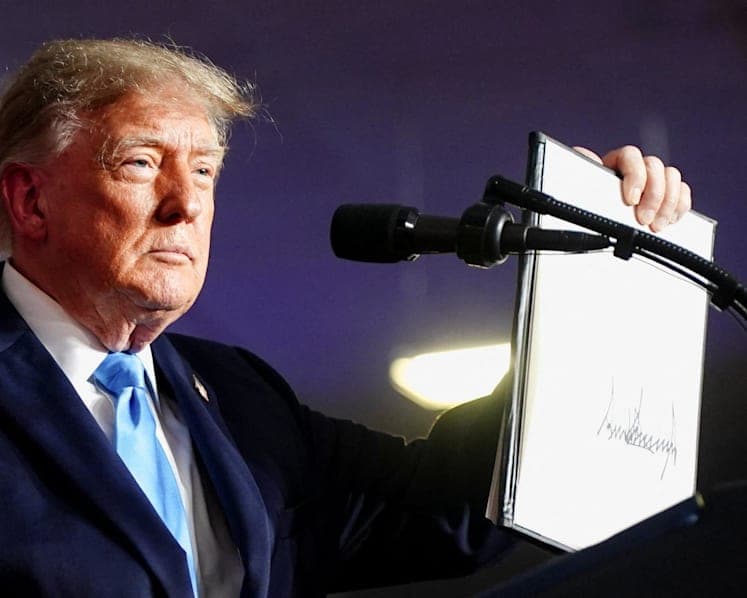
President Donald Trump made a highly visible move on fuel prices Monday night, signing an executive order onstage at a rally in Nebraska that temporarily expands access to tax-exempt red-dyed diesel.
The order was signed October 5 during Trump's campaign stop in Grand Island, where he was appearing alongside Nebraska Republicans ahead of the November midterm elections.
White House aide Natalie Harp brought the document onto the stage before Trump signed it.
The moment quickly spread across social media, where videos of the signing were accompanied by claims that Trump had effectively made diesel fuel tax-free for truckers, farmers and other Americans.
The underlying policy is real, but the details are more complicated.
Red-dyed diesel is essentially the same basic diesel fuel used by highway vehicles. The red dye identifies fuel that is normally sold for uses such as farming, construction and other off-road purposes without the taxes that apply to highway fuel.
Trump's order temporarily changes how those restrictions are enforced.
The order directs the Treasury secretary to determine which federal diesel-tax payments can be deferred under existing law and directs the IRS to provide penalty relief for the highway sale or use of dyed diesel during the relief period.
The period covered by the order runs from October 5 through December 31, 2026, subject to the legal authority and conditions outlined by the administration.
Trump said the move would provide major savings for people who depend on diesel.
The White House says the federal diesel tax is 24.4 cents per gallon. On a 250-gallon fill, that works out to about $60 in federal tax.
The administration says savings could exceed $100 per fill where states also adopt corresponding relief.
That distinction matters.
The executive order does not automatically eliminate every diesel tax across the United States.
The order directs federal agencies to work with states and encourages states to take similar action. State taxes and rules therefore remain an important part of how much a driver or business could actually save.
Trump described the move as a way to reduce pressure on truckers and farmers and ultimately lower the cost of transporting goods.
But not everyone who uses diesel will benefit in the same way.
Farmers already using red-dyed diesel for qualifying off-road purposes are generally already receiving the tax exemption. GasBuddy analyst Patrick De Haan pointed out that the biggest potential new benefit could be for on-road users who are currently paying the highway diesel tax.
The order comes as diesel prices have risen sharply, adding pressure to trucking, agriculture and other industries that depend heavily on fuel.
The timing is also politically significant.
Trump signed the order during a campaign rally for Republican candidates, including Sen. Pete Ricketts, who is facing a stronger-than-expected challenge in Nebraska's Senate race.
After signing the order, Trump told the crowd that it should help Ricketts and Nebraska Gov. Jim Pillen politically.
The administration, meanwhile, is presenting the measure primarily as an affordability effort designed to reduce the cost of fuel and transportation.
There is another important detail in the order.
Trump did not simply declare all future diesel taxes permanently eliminated.
The order directs the Treasury Department to explore ways to eliminate the obligation to eventually pay certain deferred taxes, including through possible legislation.
For now, the relief is temporary and depends on implementation by federal agencies and, in some cases, action by individual states.
So the viral claim that Trump signed an order for virtually tax-free diesel has a real policy change behind it.
But the size of the savings will depend on who is using the fuel, how much they purchase, what federal relief applies and whether their state follows the federal government's lead.
For truckers paying highway diesel taxes, the change could mean meaningful savings.
For farmers already using tax-exempt diesel, the immediate benefit may be much smaller.
And for everyone else, the question is whether the temporary tax relief will actually translate into lower fuel and transportation costs at the pump.